
Desert Hiking Kit
Here’s what you need to stay comfortable and safe in sandy, scrambly terrain.


Embarking on a desert hike isn’t the same as rambling down forested mountain paths. This water- and sand-sculpted environment can be as demanding as it is desolately beautiful, and it requires both a respect for and a knowledge of its terrain—as well as the gear to match. We’ve chosen all of these products with rigorous desert routes in mind; they’ll provide the traction, protection, hydration, and everything else you need to safely explore this uniquely tantalizing ecosystem.
 Topo Athletic Traverse ($155)
 Outdoor Research Echo Hoodie ($85)
 Outdoor Research Ferrosi Shorts 7" ($90)
 Farm to Feet Outdoor Trail Socks ($24)
 Ciele Athletics GoCap Comp Century ($55)
 Osprey Manta 24 ($220)
 Black Diamond Pursuit ($170)
 Katadyn Micropur MP1 ($18)
 Cleanwaste Wag Bag ($3)
 Gaia GPS Mapping App ($60)


The Traverse was technically designed for thru-hiking, but it’s hard to imagine a trail shoe better suited to red rock canyons and sandy washes. It delivers outstanding breathability thanks to a non-waterproof construction, impressive traction and durability for its weight, and a high degree of comfort.

Comfort

Support and Stability

Traction

Durability

Foot Protection

Sustainability


Sun protection is key in the desert, and the Echo has you covered (literally). Its hood and long sleeves will fend off harsh rays, and the shirt’s extremely thin polyester fabric provides blessed breathability.

Warmth

Breathability
Durability
Comfort

Odor Resistance
Sustainability
As with your shirt, your shorts should provide an easy-wearing mix of breathability and mobility—but they should also be able to withstand abrasive rocks and grabby desert flora. The Ferrosi offers all of that in spades, along with a smart feature set.
Desert terrain can be hard on the feet, but you don’t want to overheat in a heavy, full-cushion sock. The Outdoor Trail offers light padding and a predominantly merino wool blend that helps with temperature regulation and staves off hot spots and blisters.
Your sun hoody will do a good job of protecting your head and neck, but it’s nice to have some additional coverage. The GoCap Comp Century will do the trick, providing a dose of shade while also promoting airflow up top.
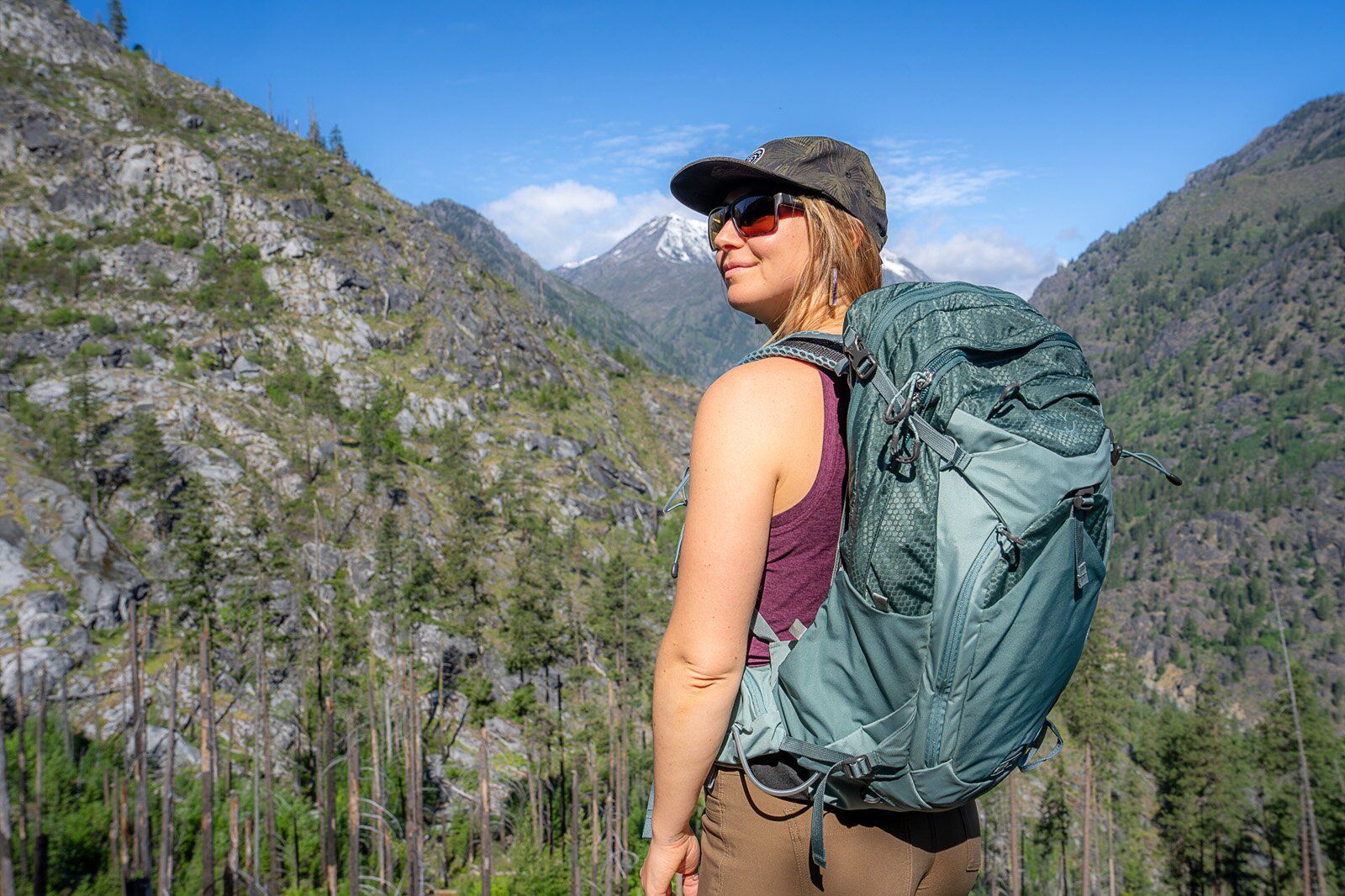


The Manta 24 (women’s Mira 22) foregrounds two essential needs in desert hiking: hydration and airflow. It comes with a water reservoir and has space for extra liquid storage, while its ventilated backpanel makes it one of the most breathable day packs overall.

Comfort & Support

Organization

Weight
Durability

Water Resistance
Sustainability


Traversing desert terrain can be tricky, whether you’re navigating around a boulder-choked canyon pouroff or pushing your way through low-traction sand. The Pursuit will help with balance and stability, and it has a host of design features that will come in handy on the trail.
Comfort
Durability
Weight

Packed Size

Features
Sustainability


Best practices for a desert day hike include bringing all of the water you need, and then some—it’s unlikely you’ll find refill spots on the trail. But these chemical purification tablets weigh nothing and will get you through an emergency if you need to hunt for hydration.

User Friendliness

Filtering Speed

Weight & Packed Size
Durability

Maintenance
Sustainability
The desert is a delicate environment, with solid waste and toilet paper taking longer to decompose. More than anywhere, practicing proper LNT is vital. This handy, packable kit makes it easier to leave only footprints (and take only photos).
Because the desert can lack some of the traditional navigation landmarks you might be used to—streams, lakes, peaks, etc.—it helps to have a mapping app on your phone. There are many options out there, but Gaia’s variety of map layers and user interface make it our favorite for warm-weather adventures.
How We Built the Desert Hiking Kit
The desert is a special place, but it asks more of you and your gear than you’re probably used to. Heat, strong sun, inconsistent water sources, and the rugged combination of slickrock, sand, and spiky vegetation are all very real obstacles you’ll have to overcome on many of the best hikes in the American Southwest, so all of the products we picked for this kit help mitigate those risks in one way or another. The most rewarding desert routes are never easy, but this gear will give you a boost.
Even compared to jagged alpine terrain, desert routes can be especially hard on your gear—and footwear most of all. Many a hiker has descended into a canyon or gone off-trail through a brushy wash and emerged with ripped uppers, chewed-up outsoles, and boots full of sand. That’s why we prioritized durability in picking a desert hiking shoe. The Topo Athletic Traverse is favored by many thru-hikers for its ability to survive hard mile after hard mile, which is all the more impressive when you consider a pair weighs less than 1.5 pounds. We’ve had a tester wear one pair of Traverses for over 650 miles on the Continental Divide Trail, which is just about as much as you can ask for from a lightweight hiking shoe (or burly leather boot, for that matter!).
High degrees of traction and breathability are also paramount in a desert shoe—you want to be able to trust your grip on rock slabs as you traverse high above a canyon floor, and you don’t want your feet to get too sweaty in the heat (that plus sand will make for some nasty blisters). The Traverse possesses both of those traits as well, courtesy of a heavily lugged Vibram Megagrip outsole and the airy (yet tough) mesh upper. It lacks a waterproof membrane, which is what you want in desert footwear—waterproofing is largely unnecessary in dry climates and not worth the compromise in breathability.
If the Traverse and its roomy foot box / narrow heel combo don’t work for you (they might not for everyone), something like the Merrell Moab Speed 2 would be a solid alternative. We recommend the non-Gore-Tex version of this burly hiking shoe, which also features a Vibram TC5+ sole and rock plate.

Desert apparel has a whole host of functions to fill, but, like footwear, it should be airy enough that you’re not constantly overheating. All of the pieces that we’ve chosen achieve that to different degrees, but let’s start from the top down. Nobody wants a burned noggin or the sun in their eyes, so wearing a hat is always recommended. Any old five-panel will probably feel too stuffy, though, so an option like the Ciele Athletics GoCap Comp Century, with its semi-solid mesh top and sides, is your best bet for letting heat escape. It also has a high UPF rating—another feature we look for in desert apparel—and the bonus of coming in three adjustable sizes. If you want a cap with more airflow (but less sun protection) due to wider mesh spacing, check out the Black Diamond Distance LT.
We chose a ball cap over a full-brim sun hat because our sun shirt pick (and most popular sun hoodies) features a hood. What’s more, the Outdoor Research Echo Hoodie’s UPF-rated polyester fabric is so light and breathable that putting the hood up to protect your neck and face won’t feel stifling. The same goes for its long sleeves, which will protect your arms from UV as well as sandstone and prickers (be careful, though, the same thinness that makes it perform so well in the heat isn’t as good for durability). Competitors like the Patagonia Capilene Cool Sun Hoody and the Mountain Hardwear Crater Lake Hoody are also excellent sun shirts with higher UPF ratings, but they are a bit heavier and warmer than the ultra-thin, ultra-breathable Echo.
It’s likely that your bottom half will see the most wear and tear as you squeeze through slot canyons and delicately pick your way around pointy yuccas, so we put more of an emphasis on well-built pieces than the absolute lightest ones. However, our choices for shorts and socks aren’t stifling in the least, and strike a necessary balance between longevity and comfort.
First up is the Outdoor Research Ferrosi, a longstanding favorite among hikers, no matter their preferred terrain. The Ferrosi, though, seems designed for the desert. Its nylon/spandex fabric can withstand rubbing on rock walls and crashing through the brush, and won’t develop holes as quickly as some lighter, polyester shorts. However, it’s not overbuilt in the least, and will still provide plenty of ventilation, as well as stretch when you’re stemming through broken red rock boulders. If you want to go even lighter (but less hardy), a short like the minimalist Patagonia Terrebonne might be better for desert runners or less strenuous routes that don’t involve getting thrashed.
Just as you wouldn’t choose a thick, heavy hiking boot, picking a sock with lots of cushion probably wouldn’t go over very well once you’re in the furnace. Opting for one with light cushion is thus the way to go, and that’s exactly how the Farm to Feet Outdoor Trail is designed. It still has a bit of padding on the sole—not a ton, but you’ll appreciate it when you’re pounding on slickrock for miles or taking twisting steps in sand—and a majority merino blend that will wick away sweat. What’s more, a good amount of nylon will help the Outdoor Trail from ripping or pilling during its first scrape with sandstone. If its aesthetics aren’t to your liking, Smartwool also makes a lightly cushioned sock with a similar fabric blend called the Performance Hike Light Cushion Crew.
Rule number one of desert hiking: Bring enough water for your entire hike—and then carry some more on top of that. Water sources are few and far between (and sometimes nonexistent), so you can’t rely on refilling over the course of your route like you would normally. The focus on hydration—as well as our old friend breathability—was a major reason we chose the Osprey Manta 24 (women’s Mira 22) as our desert hiking pack. It comes standard with a 2.5-liter reservoir and hose, which will automatically become your main source of hydration. Two side pockets can each fit a water bottle, so you should have plenty of fluid to get you through the day (you can throw a bottle in the main compartment as well, of course).
In addition to its H2O-promoting qualities, the Manta is also an exceptionally well-built pack. Its trampoline-style backpanel provides much-needed airflow across your back—a blessing when the sun is beating down—and a wire perimeter frame will keep all its contents stable, which is important when you’re carrying so much water weight. Pockets galore will hold the additional gear and food you bring (remember, you need calories and sodium as well as water to function on a strenuous, sweaty hike), and the Manta also has handy attachments for stowing your trekking poles when you need all four limbs to monkey up a slickrock shelf. For a similar pack with an included hydration reservoir and a trampoline backpanel that’s even a little more affordable, peep the Gregory Citro 24 H2O.
The Manta can also, of course, hold a small water filter, but we don’t recommend bringing one. As we noted, you should bring enough water for your entire hike, and it’s far from a guarantee that you’ll even find a source along your route. However, it costs you pretty much nothing—both in terms of packing space and money—to bring along a chemical water purifier should things go extremely awry. Katadyn Micropur MP1 Tablets will make water from even the nastiest-looking pothole safe to drink, but you should definitely use a pre-filter first to remove the inevitable sand. A coffee filter or a handkerchief will do the trick, and this is where bringing along extra water bottles, in addition to the Manta’s reservoir, comes in handy as well.
First, a quick note on caring for your desert surroundings. Because of the environment’s extremely arid nature, it’s even more delicate than other biomes frequented by hikers. That applies to everything in the desert, from soft sandstone rocks to slow-growing plants to animals to water sources. But it’s especially true when it comes to cryptobiotic soil crusts, which are living soil crusts made of cyanobacteria. They take the form of blackened, raised knobs on the desert floor, and they’re essential to providing nutrients for plant life and preventing erosion. Cryptobiotic soil takes a long time to grow and is easily damaged if you step on it. If you’re in an area with this type of soil, make sure to stick to hard, durable surfaces, even when you’re hiking off-trail.

And when you’re on those hard, durable surfaces (also known as rocks and established trails), you might want to consider using the screw-on rubber tips you can buy for Black Diamond’s Pursuit Trekking Poles. Nobody wants to delve into a wonderland of slickrock and find it marked up by the carbide tips of previous hikers’ poles. It’s great that the Pursuit’s tips are interchangeable, and the screw-on ones are much more secure than rubber tip caps that sometimes fall off. You can always put the Pursuit’s carbide tips back on when you transition back to the mountains, but no matter where you are, these are reliable poles with long, comfortable grips and well-designed adjustment levers. If you want to pare your kit down a little, check out the Pursuit FLZ or the Pursuit Carbon Z and FLZ, which are even lighter and folds down much smaller.
Finally, to round out our desert conservation discussion: Bring a Wag Bag—yes, even on a day hike. It’s the environmentally friendly and sanitary thing to do. If you don’t end up using it, your friend probably will.
Is the Desert Hiking Kit for You?
If you like exploring the serenity, solitude, unique plant life, and otherworldly rock formations of the Southwest, the gear above will help you thrive on your desert adventures. Having said that, all of the products we picked for this kit are fantastic choices for general hiking as well, and will excel in more “normal” environments. We stand behind all of them, of course, but if you want our recommendations for the absolute best of the best when it comes to hiking gear, check out our Editors’ Picks Hiking Kit.


