


The North Face Stormbreak 2 Tent Review


The North Face’s Stormbreak 2 ($220) is a popular tent for good reason. It strikes a nice balance for short backpacking trips and car camping, with ridge poles that boost interior space, garage-door-style vestibules that open things up for basecamp use, and enough room for two adults to sleep comfortably. As with most cheap tents, it’s too heavy for extended backpacking, and the flimsy stakes and finicky zippers were ongoing annoyances. Still, its overall livability makes it one of the best options in the budget category.

Interior Space

Weight & Packed Size

Weather Protection

Durability

Ease of Use

Sustainability
Design Type
Freestanding
Packaged weight
5 lb. 14.2 oz.
Floor Area
30.5 sq. ft.
Floor dimensions
87 x 50 in.
Peak height
43 in.
Floor Fabric
75D polyester
Capacities
1, 2, 3P
Pros
Cons
The North Face Stormbreak 2
For this season's top models, see our guide to the Best Backpacking Tents.
The Stormbreak 2 stands out among budget tents for its surprisingly roomy and livable interior. A pair of ridge poles across the top creates noticeably better headroom than most tents in this price range, which often rely on heavily sloped walls that feel cramped. With a 43-inch peak height—3 inches taller than the REI Trailmade 2—and a rectangular floor plan, the Stormbreak makes it easy to sit up, change clothes, and move around without feeling confined. While its total floor area (30.5 sq. ft.) is slightly smaller than the Trailmade’s (31.8 sq. ft.), the more vertical walls and added structure make it feel significantly more spacious in practice.
One of our testing trips with the The North Face Stormbreak 2 was a four-night trip in Tahoe National Forest while racing the Downieville Classic, and the added space was immediately appreciated. With two adults (6’1” and 5’10”) inside, we were able to sleep comfortably using one 25-inch and one 20-inch pad, though fitting two 25-inch-wide pads side by side would be a stretch. The layout allowed us to sleep head-to-foot and move around at night without disturbing each other. Adding to the sense of space are the generously sized vestibules—each around 10 square feet—with a unique garage-style opening that rolls up from the middle. In good weather, this design opens the tent up significantly and makes getting in and out far easier than traditional single-sided vestibules.

The Stormbreak 2 falls squarely into the “burly but bulky” category when it comes to weight and packed size. At 5 pounds 14 ounces all in, it’s slightly lighter than its main budget competitor, the REI Trailmade 2 (6 lb. 4 oz.), although it’s worth noting that the Stormbreak doesn’t include a footprint (so they’re effectively the same). Given its tough 68-denier floor, we don’t see that as a major omission—but either way, these are heavy tents. Even stepping up to mid-range options like the Nemo Aurora 2 (5 lb. 10 oz.) or REI Half Dome (5 lb. 15.1 oz.) doesn’t save much weight, which highlights a core tradeoff in this price bracket.
The packed size reinforces that reality. At 7 x 22 inches, the Stormbreak takes up a substantial amount of space—roughly double what we’re used to with lightweight backpacking tents. When car camping or on shorter trips, that’s manageable, especially if you can split the load between two people. But the bulk becomes more noticeable on longer trips, once you factor in food and extra layers. On that Utah overnight, we were able to squeeze the tent and a bulky REI Radiant 20 sleeping bag into a 45-liter pack—but just barely, and that was with minimal food. For multi-day trips, expect to need more pack space and to carry a heavier overall load, which is where the Stormbreak’s limitations really show.

The North Face Stormbreak 2 provides solid protection for typical three-season use, especially in the moderate storms you’re likely to encounter during summer camping. The full-coverage rainfly is seam-sealed with a PU coating and has kept us dry in testing so far, although we haven’t yet subjected it to a true downpour. It also features guyout points along the sides for added stability, and we were able to achieve a fairly taut pitch that avoided the excessive flapping common in budget tents. In light wind, the tent remained quiet and secure.
That said, coverage isn’t perfect. The fly doesn’t extend all the way to the ground, leaving parts of the tent body slightly exposed to splashing water, although the seam-sealed, PU-coated floor should handle most moisture short of heavy pooling or prolonged rain. The taller profile and pole structure prioritize interior space over outright storm-worthiness, so it’s not a tent we’d push into harsher conditions or shoulder-season weather. Still, with proper setup—and ideally upgraded stakes (we cover our complaints about the stakes in “Durability” below)—the Stormbreak holds its own for fair-weather trips and moderate conditions.

Durability is a bit of a double-edged sword with the Stormbreak 2, which is common in this price range. On one hand, the fabrics themselves are impressively tough. The tent uses a 68-denier polyester floor and 75-denier polyester for the canopy and rainfly—far burlier than many ultralight tents that dip into the 15-denier range or lower. In practice, that thickness inspires confidence. We didn’t feel the need to use a footprint in testing, and the floor held up well to repeated use on a variety of surfaces. If you’re mostly car camping and want to be extra cautious over the long haul, you can add The North Face’s dedicated footprint for around $50 (or cut your own for much less), but for most users, it’s not a necessity.
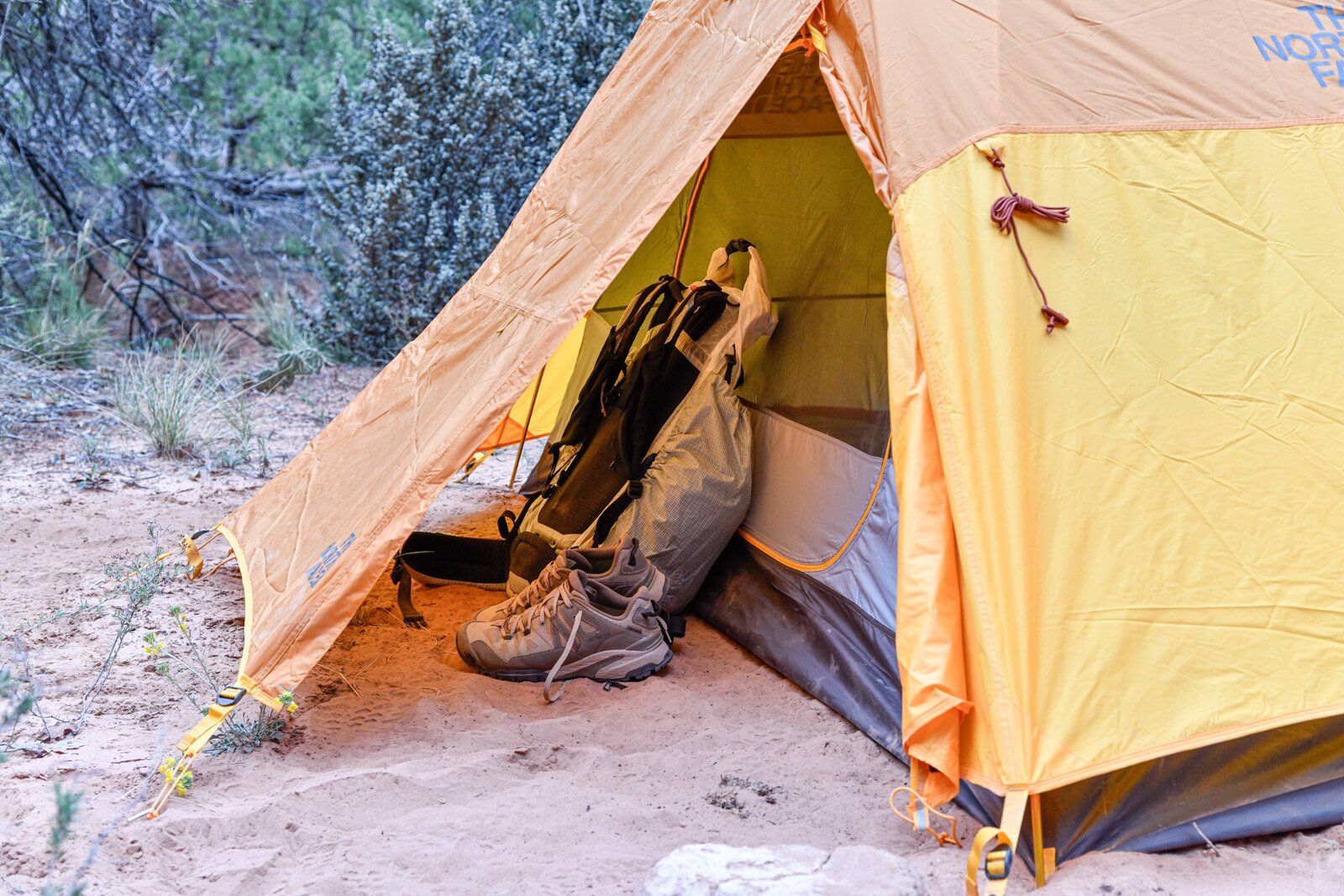
The smaller components tell a different story. The included stakes are thin steel with a shepherd’s hook design, and they feel noticeably cheap. They worked fine in softer ground—like the sandy terrain we encountered in Utah—but struggled in firmer conditions. While pitching in the hard, sun-baked dirt of the northern Sierra Nevada, we had to be extremely careful, and even then, several stakes bent more easily than we’d expect. We’d strongly recommend replacing them right away if you plan to camp on tougher ground. The zippers are another weak point: they tend to catch frequently, and if you’re not deliberate when opening and closing the doors, it’s easy to snag the fabric or mesh. Over time, that could lead to damage, especially if you’re in a hurry or using the tent in the dark.


Setting up the The North Face Stormbreak 2 is refreshingly straightforward. The clipped-pole system is intuitive, and the color-coded grommets make lining up the tent body and rainfly easy. There are four poles in total, but only two lengths—long poles for the main X structure and shorter ones for the ridge—so it’s easy to sort and assemble, even solo. In practice, we had the tent up quickly without much thought.
Where things fall apart a bit is with the doors. Simply put, the zippers are some of the least intuitive the Better Trail team has used. There’s a panel of solid fabric that interrupts the zipper path in a way that feels counterintuitive—it sits right where you naturally want to keep zipping, almost as if it were designed backward. (And yes, we double-checked that the rainfly was oriented correctly.) On top of that, the zippers catch frequently, often requiring two hands to guide them smoothly. Over time, we got used to the process—and the large vestibule opening helps offset some of the frustration—but compared to more straightforward designs like the REI Trailmade, it’s a noticeable annoyance in day-to-day use.


Select icon to view details:


Longevity
Choosing durable outdoor gear and keeping it in use for longer is one of the best ways to reduce environmental impact. Our proprietary longevity rating assesses factors like overall build quality, materials, fabric denier, component durability, and real-world performance. A green check indicates that we expect the product to be long-lasting relative to its peers, a yellow check mark indicates average longevity, and a red X indicates a product that may have a limited lifespan.
PFAS-Free DWR
Durable water-repellent (DWR) finishes can contain PFAS (per- and polyfluoroalkyl substances). These highly persistent “forever chemicals” are used in outdoor gear for their strong resistance to water, oil, and heat, but are linked to environmental contamination and a range of health concerns. A green check mark indicates the product uses a PFAS-free DWR, while a red X means the DWR contains PFAS.
Recycled Materials
Recycled materials are prevalent in outdoor gear, with nylon, polyester, wool, and down among the most common, but the composition varies widely. A green check mark indicates the product is made with a substantial amount of recycled materials (100% recycled or the core fabric that makes up most of the product is recycled), a yellow check means it contains a moderate to small amount of recycled materials, while a red X means there are no recycled materials in the product.
Bluesign Approved
Bluesign Technologies, based in Switzerland, operates a third-party textile management system that ensures materials are manufactured to strict environmental, chemical, and worker safety standards. A green check mark indicates a product is either a Bluesign Product (contains at least 90% Bluesign-approved fabrics and 20-30% Bluesign-approved accessories) or features a significant amount of Bluesign-approved materials. A yellow check mark means it uses some Bluesign-approved materials but less than the aforementioned category, and a red X means there are no Bluesign-approved materials in the product.
Solution-Dyed Materials
Solution dyeing adds pigment to synthetic fibers during production rather than afterward, reducing water use, energy consumption, greenhouse gas emissions, and chemical waste, while also creating fabrics that resist fading better over time. A green check mark indicates a product features a substantial amount of solution-dyed materials, a yellow check mark indicates moderate or limited use of solution-dyed fabrics, and a red X indicates there are no solution-dyed materials in the product.
Responsible Manufacturing
This criterion evaluates a brand’s commitment to fair wages, safe working conditions, and reducing environmental impact through certifications and programs like Fair Trade Certified, Fair Wear Foundation, Worldwide Responsible Accredited Production (WRAP), and the Fair Labor Association, while also recognizing brands that manufacture primarily in the U.S. or Europe under strict labor and environmental regulations. A green check mark indicates a brand meets our responsible manufacturing criteria, while a red X means it does not.
Recycled and/or Reduced Packaging
Packaging can add significant waste to outdoor gear purchases, so many brands work to reduce its impact by using recycled materials, incorporating Forest Stewardship Council-certified paper products, and minimizing plastic and paper use. A green check mark indicates a brand uses recycled or reduced materials across all of its packaging, a yellow check indicates moderate or limited use of recycled or reduced packaging, and a red X indicates the brand does not make either of these efforts.
Repair Services
Repair services extend the lifespan of outdoor gear and reduce overall consumption, though programs vary widely. Some brands offer comprehensive repairs for a range of issues, while others provide limited or no repair support. A green check mark indicates a robust repair program, a yellow check mark indicates limited repair services, and a red X indicates the brand does not offer repair services.
Resale and/or Recycling Services
Resale and recycling programs help keep outdoor gear in circulation longer and out of landfills, ranging from trade-in resale platforms that offer store credit to take-back initiatives that recycle products at the end of their usable life. A green check mark indicates a brand offers both resale and recycling programs, a yellow check mark indicates it offers one or the two, and a red X indicates it offers neither.
Carbon Footprint Tracking
This criterion evaluates whether a brand measures, reports, and works to reduce its greenhouse gas emissions using established frameworks such as the Higg Index, Greenhouse Gas Protocol, or The Change Climate Project. A green check mark indicates a brand publicly reports greenhouse gas emissions data, sets clearly defined reduction targets, and uses established tracking frameworks such as Higg or The Change Climate Project. A yellow check mark indicates the brand tracks emissions and outlines reduction goals but provides limited data, lacks science-based verification, or does not clearly report progress. A red X indicates the brand does not appear to track greenhouse gas emissions or provides so little information that its efforts cannot be verified.
Annual Impact Report
Annual impact reports provide transparency and accountability by outlining a brand’s sustainability efforts across areas such as material sourcing, greenhouse gas emissions, waste, water use, supply chains, and packaging. A green check mark indicates a brand publishes a detailed, brand-specific impact report that closely aligns with our sustainability criteria and leaves little room for ambiguity. A yellow check indicates a brand provides some relevant sustainability reporting but lacks detail in key areas or is covered only briefly within a parent company report. A red X indicates a brand does not regularly publish an impact report.
The Stormbreak 2 strikes a nice balance between mesh and solid fabric, which helps it manage airflow better than many budget tents. The middle section of the tent body is almost entirely mesh, promoting good cross-ventilation, while the fabric panels at the top provide protection. With the rainfly properly staked out, there’s also enough space between the fly and tent body at the base to allow air to circulate, which helps reduce stuffiness.
That said, like most backpacking tents in this category, it can still get warm with the fly fully on in hot conditions. This is where the Stormbreak’s vestibule design really helps. The large, garage-style doors can be left open at night to maximize airflow, then quickly closed if weather rolls in. During our testing in the Sierra Nevadas with daytime highs in the 80s, being able to fully open the vestibules made a noticeable difference in keeping the interior comfortable.

Interior Storage
The Stormbreak 2 keeps interior storage simple but effective. Four pockets—one in each corner—provide enough space for organizing essentials on backpacking trips or short camping outings, and the layout works especially well if you’re sleeping head to foot. We were able to stash cold-weather gear like gloves and a hat in one pocket during chilly nights at elevation, while the opposite side held a headlamp and other nighttime essentials. A nice bonus is that the lower pockets double as storage for the doors: when fully unzipped, you can tuck the fabric neatly into the corners, which keeps things tidy and off the ground.
Vestibules
The vestibules are a standout feature of the Stormbreak 2. At just under 10 square feet each, they’re generously sized for a tent in this category, and the garage-style openings are both fun and genuinely practical. Unlike traditional flap-style vestibules that you can open but often don’t, these feel inviting to use and make getting in and out of the tent noticeably easier. The design does require an extra stake on each side compared to a standard triangular vestibule, but the added space and flexibility are well worth it. On gear-heavy trips, like our mountain biking basecamp in Downieville, the extra room and usability were a big plus.
REI Co-op Trailmade 2 ($199): A Simpler (and Cheaper) Alternative
The Trailmade 2 undercuts the Stormbreak by about $20 and offers a more straightforward, no-frills design. That simplicity has its benefits: the zippers are more intuitive, and the included stakes are thicker and more durable (though still not premium). That said, the Stormbreak is the more refined tent overall, with a stronger pole structure, better headroom, and a more functional vestibule design with improved ventilation. Both work well for a mix of car camping and light backpacking, but we give the edge to the Stormbreak—especially if you’ll regularly have two adults sharing the space. For more, check out our review of the Trailmade 2.
Nemo Aurora 2P ($300): Upgrades All Around
The Aurora 2P shares a similar crossover design as the Stormbreak—roomy enough for car camping but still manageable for short backpacking trips—but it brings a number of meaningful upgrades. Interior space is even better thanks to its dual-hubbed pole structure, which creates more vertical end walls compared to the Stormbreak’s sloping design, and total floor area is slightly larger at 32.4 square feet (vs. 30.5). Durability also holds its own despite the more premium build. The main downside is weight: like the Stormbreak, it’s still fairly heavy, so it occupies a similar niche. Ultimately, it comes down to whether those added refinements are worth the higher price.
Impressively roomy thanks to its unique pole shape, the Stormbreak 2 is a comfortable two-person option for backpackers looking to save. You'll want to replace the cheap stakes and the door zippers can be finicky, but the overall build represents a good value.

Interior Space

Weight & Packed Size

Weather Protection

Durability

Ease of Use

Sustainability

The Trailmade offers a lot of value for new and occasional backpackers. You get a surprisingly durable build, an easy-to-set-up layout, and enough floor space to comfortably fit two sleeping pads. The tent is heavy and offers limited headroom, but it’s a great option for those on a budget.
Interior Space
Weight & Packed Size
Weather Protection
Durability
Ease of Use
Sustainability

A strong mid-range option, the Aurora 2 is well-made, extremely spacious, and feature-rich. It's too heavy to be fun to haul far into the backcountry, but the design has a lot of appeal for casual backpacking and camping crossover use.
Interior Space
Weight & Packed Size
Weather Protection
Durability
Ease of Use
Sustainability
Is the Stormbreak 2 for You?

The North Face Stormbreak 2 is a great match for budget-minded backpackers and campers who prioritize a functional layout for two adults. Its roomy interior, generous vestibules, and intuitive setup make it especially appealing for short backpacking trips, basecamping, or car camping where comfort matters as much as cost. That said, the weight and packed size make it a no-go for longer backcountry trips, and the finicky zippers and flimsy stakes are worth factoring in. In the end, it’s one of the best budget models we’ve tested, especially for those who prioritize roominess.

get outside
Backpacking Gear Guides

Gear Guide
Best Backpacking Backpacks of 2026
Gear Guide
Best Backpacking Sleeping Pads of 2026
Gear Guide
Best Backpacking Sleeping Bags of 2026
Gear Guide
Best Trekking Poles of 2026
curated for you